Why Porcelain Turns Translucent at the Edge
Why porcelain turns translucent at the edge: learn how wall thickness and body composition shape the glow, and how to judge the effect without mistaking it for quality.
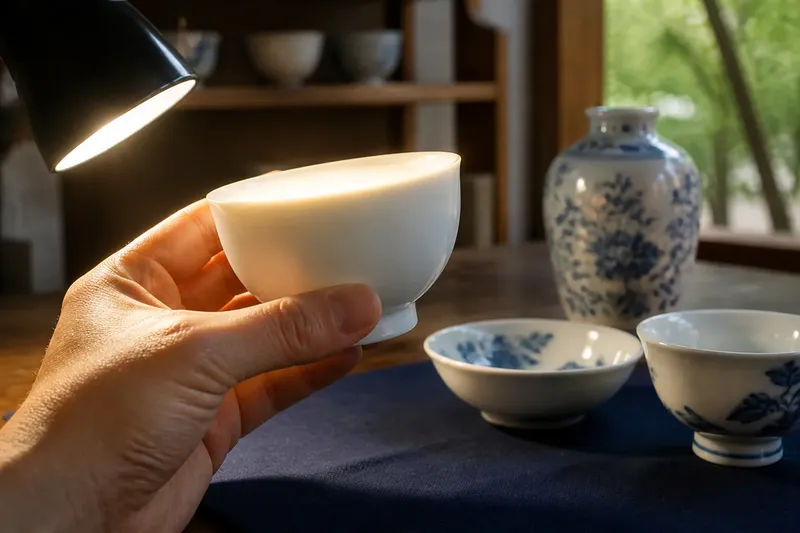
Why porcelain turns translucent at the edge becomes clear when you hold a thin rim between a lamp and your eye: light can pass through a narrow section of the fired body, while the thicker centre stays opaque. The glow is a useful clue to how a piece is made, but it is not a quality test on its own.
To read the effect sensibly, start with the light, compare different parts of the same object, then consider the porcelain body and the object’s purpose. That order helps separate a real material characteristic from a trick of contrast or a pleasing but incomplete sales claim.
What does translucency at the edge actually show?
Porcelain scatters and absorbs light as it passes through the body. At a thin edge, the light travels through less material, so more may emerge on the other side. As the wall thickens, the path through the body lengthens and the transmitted light fades.
Look for a gradual change rather than a simple switch between transparent and opaque. A rim may glow softly while the shoulder below it dims; a foot or handle may remain dark because it is thicker. Glaze, decoration, curvature and the direction of the light can all alter what you see.
Translucency does not mean that the porcelain is clear like glass. The light is diffused by the ceramic body, so the edge often appears milky, warm or softly luminous. The effect may be easier to see against a dark background than against a bright window.
How should you check a piece in ordinary light?
Begin with a small, steady light source, such as a desk lamp or a phone torch. Choose a plain area of the vessel if possible, away from painted decoration, a thick foot or a strongly curved handle. Hold the light on one side and observe the opposite side without pressing the object against the lamp.
Then compare locations on the same piece. Move from the rim towards the body, or compare a thin wall with a visibly thicker base. Keep the lamp in roughly the same position so that changing brightness is less likely to come from moving the light rather than changing wall thickness.
Next, change the background. A dark cloth behind the porcelain may make a faint glow easier to distinguish; a pale surface can make it seem weaker. If the result changes sharply with background or lamp angle, treat that as a reminder that this is an observation, not a verdict.
Say you are looking at an undecorated Arita-style cup under a desk lamp. You notice a muted glow at the rim, then little light through the thicker lower wall. If you turn the cup and find the same gradual shift around its circumference, you can reasonably describe where the body transmits light; you still cannot infer its overall quality from that alone.
Why do thickness and composition matter together?
Thickness is the most immediate influence because it changes how much material light must cross. A thinly thrown wall can therefore look more translucent than a thick one made from a similar body. Even within one vessel, a rim, shoulder, foot and handle can produce different readings.
Composition matters because porcelain bodies vary in their ingredients and in how those ingredients behave during firing. Their mineral makeup, particle structure and degree of vitrification affect how light is transmitted or scattered. Two pieces of similar thickness can consequently show different levels of translucency.
Firing and forming also leave their mark on the result. The body must be sufficiently vitrified for the particular porcelain recipe, while the wall’s shape and consistency influence the path of light. These factors interact; looking at translucency alone cannot tell you exactly which material or firing conditions produced it.
Glaze adds another layer to the view. A clear glaze can change surface reflection, while an opaque glaze or dense decoration may mask the body. A bare foot, an unglazed patch or a thin undecorated rim may offer a clearer view, but none is a complete sample of the object’s composition.
What can translucency tell you—and what can’t it?
It can tell you that some light is passing through a particular part of the body under the conditions you are using. In a careful comparison, it can help you notice changes in wall thickness or differences between pieces. It may also explain why a fine rim looks delicate beside a dense base.
It cannot establish that a vessel is well made, durable, authentic, old or suitable for a particular use. A strongly translucent wall may be intentionally thin; a less translucent wall may reflect a different body recipe, a thicker form or a glaze that obscures the effect. Neither result settles the broader judgement.
For an object you plan to use, assess the rim, foot, handle, balance and surface condition as separate features. Consider whether the form suits its intended task, and inspect for visible cracks, chips or repairs. If a maker’s care instructions or a product label set limits on use, follow those rather than relying on the glow at the edge.
Which questions help you interpret the glow?
Does every porcelain piece become translucent?
No. The effect varies with the body, thickness, glaze, decoration and lighting. A particular piece may show little visible transmission even though it is porcelain.
Does a brighter rim mean better porcelain?
Not by itself. A brighter rim can result from a thinner wall or a body that transmits more light, but it does not independently establish craftsmanship or suitability for use.
Why does the glow disappear when I move the lamp?
Light direction and reflections can change what reaches your eye. Try a steady lamp and compare nearby sections without changing its position; the result should still be treated as a visual clue, not a material diagnosis.
Can painted decoration hide translucency?
Yes. Dense decoration, coloured glaze or an opaque layer can block or scatter light before it passes through the body. Look for an undecorated area if one is available, while remembering that it may differ in thickness from the rest.
Which observations are worth recording?
- Where the glow appears: note whether it is confined to the rim or continues into the wall.
- How it changes across the form: compare thin and thick sections under the same lamp.
- What covers the surface: distinguish bare, clear-glazed and decorated areas.
- How the background affects it: check whether the effect remains visible against light and dark surroundings.
- What the piece is meant to do: judge practical suitability from its form and condition, not from light transmission alone.
There is little value in using a powerful torch, repeatedly pressing a lamp against a fragile rim or treating a dramatic glow as a certificate of excellence. A calm comparison in ordinary light is enough to describe what you can see.
When you next examine porcelain, use “translucent at the edge” as a precise observation: name the area, note the light and compare it with a thicker part. That small distinction makes the phrase more useful, and keeps the beauty of the glow from carrying claims it cannot support.