A Rainy-Day Cupboard Sort for Fragile Tableware
A rainy-day cupboard sort for fragile tableware makes daily cups easier to reach and delicate porcelain less likely to be jostled during ordinary use.
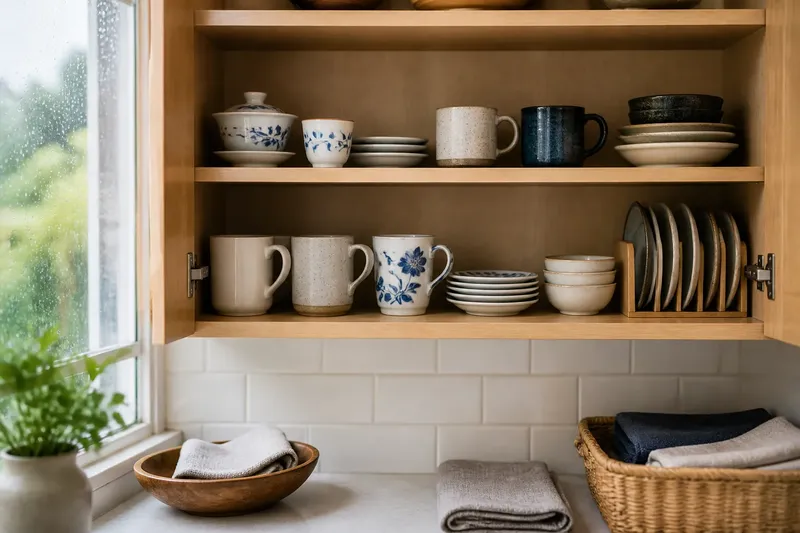
A rainy-day cupboard sort for fragile tableware starts with one simple change: put the pieces you use every day where your hand can reach them without shifting anything else. Imagine a fictional household on a wet Saturday, with Arita porcelain, everyday mugs and a crowded kitchen cupboard. The aim is not to create a display or restore a matching set. It is to make the cupboard calmer to use while giving delicate pieces their own steady place.
What is making the cupboard awkward?
In this invented situation, the household has cups stacked in two uneven towers. A small Arita cup sits behind a heavier mug, and saucers are wedged upright between serving dishes. Nothing is visibly broken, but getting breakfast out means moving several pieces first. That repeated shuffling is the problem to solve.
Before moving anything, the household opens the cupboard and looks at how it is used. Which shelf holds the cups reached for each morning? Where does someone have to stretch or lift another piece out of the way? Are there items that come out only for guests or special meals? These observations set the order better than arranging by colour or matching every pattern.
They clear a dry work surface nearby and bring out a soft cloth. Then they remove one shelf’s contents at a time, keeping the next shelf untouched until the first is sorted. This keeps the job manageable and makes it easier to remember where each piece came from.
How should everyday pieces be grouped?
The household begins with frequency of use. Daily mugs and cups go together on a shelf that can be reached comfortably. Their usual saucers sit beside them, rather than below a pile of less-used dishes. Pieces used for tea or coffee only now and then can occupy a higher or less convenient shelf, provided they can be lifted out without disturbing the daily group.
They also consider shape. Cups with handles are arranged so a hand can approach them without catching another handle. Small bowls and saucers sit in stable, modest stacks, with like shapes together where that makes lifting easier. The plan does not require every item to have a single perfect position; it needs a clear route in and out.
For the Arita porcelain, the household resists treating a decorative piece as automatically too precious to use. One sturdy cup is used regularly, so it belongs with the daily cups if it can sit securely and be removed freely. A more delicate cup, brought out only for occasional gatherings, receives a separate spot. The distinction follows actual handling and use, not the name of the ware.
Where do delicate pieces belong?
The household sets aside a stable area for the pieces that should not be crowded: a thin-walled cup, a small lidded vessel and a saucer with an easily caught edge. They place each on a level shelf with room to grasp it directly. No piece is tucked behind a heavier one, and nothing rests on top of a delicate cup or lid.
They avoid making tall stacks merely to free shelf space. A short stack of similar saucers may be easier to manage than a tower, while cups are kept upright rather than nested if nesting makes them stick or scrape. When shapes differ, the safer arrangement is usually the one that lets each item be lifted without twisting or levering it against its neighbour.
For a piece with a lid, the household keeps lid and vessel together, but does not force the lid into place for storage. That makes the pair easy to find and avoids turning a cupboard sort into an attempt to correct a fit. Any uncertainty about a particular item’s handling or storage should be settled by its maker’s guidance or a suitably qualified ceramics professional.
What should change before the cupboard is considered settled?
Once the groups are in place, the household tries the ordinary motions that caused trouble: reaching for a morning mug, returning a saucer, and taking out the occasional-use cup. They notice whether a hand must pass over another piece, whether a handle catches, and whether a stack shifts when something is removed. If an arrangement asks for careful manoeuvring every time, it needs another adjustment.
Say the fictional household discovers that the daily mugs fit comfortably on the lower shelf, but the Arita cup’s handle catches against a neighbouring bowl. They move the bowl to the occasional-use group and give the cup a clear space beside the mugs. The observable result is straightforward: the cup can now be lifted by its body and handle without nudging the bowl or shifting a stack.
They leave a little breathing room rather than filling every gap. Empty space is useful when pieces need to be returned after washing, and it prevents a shelf from becoming a puzzle again as soon as another cup appears. It is not worth spending the afternoon arranging every item into a perfect visual pattern; a tidy-looking cupboard that still requires awkward lifting has missed the point.
Which cupboard questions matter most?
Should Arita cups be stored separately from everyday mugs?
Not automatically. Place a cup with the daily group if it is used often and can be lifted without contact or crowding; reserve a quieter place for pieces that are especially delicate or rarely used.
Is it better to stack saucers or stand them upright?
Choose the arrangement that stays stable and allows direct access. A low stack of similar saucers may be simpler than a crowded upright row, but avoid a tall pile that has to be steadied whenever one is removed.
Where should seldom-used tableware go?
Keep it away from the busiest reach, but not behind a precarious stack of daily pieces. A higher or less central shelf can work if the items remain accessible without stretching or shifting other tableware.
How can a cupboard stay organised after the sort?
Return each group to its assigned area and leave room for the pieces that actually get used. If a new item makes a shelf crowded, reconsider the grouping rather than squeezing it into a gap that makes other pieces harder to handle.
What does this sort teach about storing porcelain?
By the end of the rainy-day sort, the fictional household has not transformed its cupboard into a collection display. It has made the daily route shorter, separated the pieces that need more space and removed the small obstacles that invited bumps. Those are useful lessons for Arita porcelain and other fragile tableware alike: arrange around real habits, let each piece come out cleanly, and treat empty shelf space as part of the arrangement.
A rainy-day cupboard sort for fragile tableware can stay modest. Start with the shelf that causes the most shuffling, make one clear change, and use the cupboard normally before moving on. A calm arrangement is not one that never changes; it is one that makes the next reach feel easy and leaves delicate pieces undisturbed.